UK Paperback
Diversity and Inclusion in Environmentalism
ABINGDON: Routledge
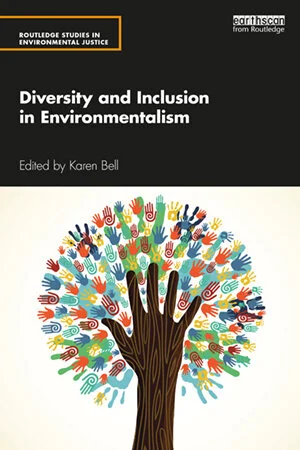
This book discusses how to develop green transitions which benefit, include and respect marginalised social groups. It explores the challenge of taking into account issues of equity and justice in the green transformation and shows that ignoring these issues risks exacerbating the gap between the rich and the poor, the marginalised and included, and undermining widespread support for climate change mitigation.
REVIEWS
As issues of equity and justice move centre stage worldwide, how do we develop a responsive, unified, intersectional environmentalism? This challenge is not new, but Bell has assembled an excellent collection that utilizes academic, personal and experiential perspectives to give us fresh, creative new ideas.
Julian Agyeman, Professor of Urban and Environmental Policy and Planning, Tufts University
A well-timed, much needed holistic approach to the ways in which social inequalities such as class and disability are manifested in mainstream environmentalism. Everyone involved in environmental campaigning should read this book!
Lucie Marks, Key Relationships Officer, Greenpeace UK
This book pulls together social movements from around the world that have been at the frontline of fighting for climate justice. It will support the growing movement for socially just environmental policies like the Green New Deal.
Natasha Josette, Community Organiser, Green New Deal
This book is a much needed, detailed dissection of the lack of diversity within the environmental sector. It is thoroughly researched and sets out everything the sector needs to know to make the change.
Mya-Rose Craig AKA Birdgirl, conservationist, environmentalist and race activist

UK Paperback
WORKING-CLASS ENVIRONMENTALISM: aN AGENDA FOR A JUST AND FAIR TRANSITION TO SUSTAINABILITY
London: Palgrave Macmillan
This book is about how to develop green transitions which benefit, include and respect working class people. The book will challenge current practice, policy and thinking by highlighting how discriminatory and undermining actions and attitudes towards working class people are preventing the attainment of sustainability.

UK Hardback
Achieving Environmental Justice: A Cross-National Analysis
Bristol: Policy Press
In this book I address the topic of environmental justice, conceptualised as the aspiration for a healthy environment for all social groups, as well as fair and inclusive processes of environmental decision making. The work connects the global and the local through evaluating seven diverse countries – United States, Republic of Korea, United Kingdom, Sweden, China, Bolivia and Cuba. It brings together diverse but coherent local stories, from the destruction of a community market on the council housing estate where I live to waste dumping on indigenous Mohawk land in New York State. Rigorous secondary data analysis is integrated with primary fieldwork research, including 140 interviews with a diverse range of politicians, experts, activists and citizens.